

Comprehensive Therapy Options for Herniated Disc Relief
What Is Herniated Disc Pain Therapy — and What Are Your Options?
Herniated disc pain therapy covers a range of treatments designed to relieve nerve pressure, reduce inflammation, and restore normal movement in your spine. Here’s a quick look at the most common options:
| Treatment Type | Examples | Best For |
|---|---|---|
| Conservative/Home | Ice/heat, rest modification, activity changes | Mild to moderate symptoms |
| Physical Therapy | Core strengthening, stretching, McKenzie method | Most herniated disc cases |
| Chiropractic Care | Spinal manipulation, spinal decompression | Nerve compression, radiculopathy |
| Medications | NSAIDs, muscle relaxants, steroid injections | Pain and inflammation control |
| Advanced Non-Invasive | K-Laser therapy, spinal decompression | Cases resistant to basic PT |
| Surgery | Microdiscectomy, laminectomy | Last resort after 6+ weeks of failed conservative care |
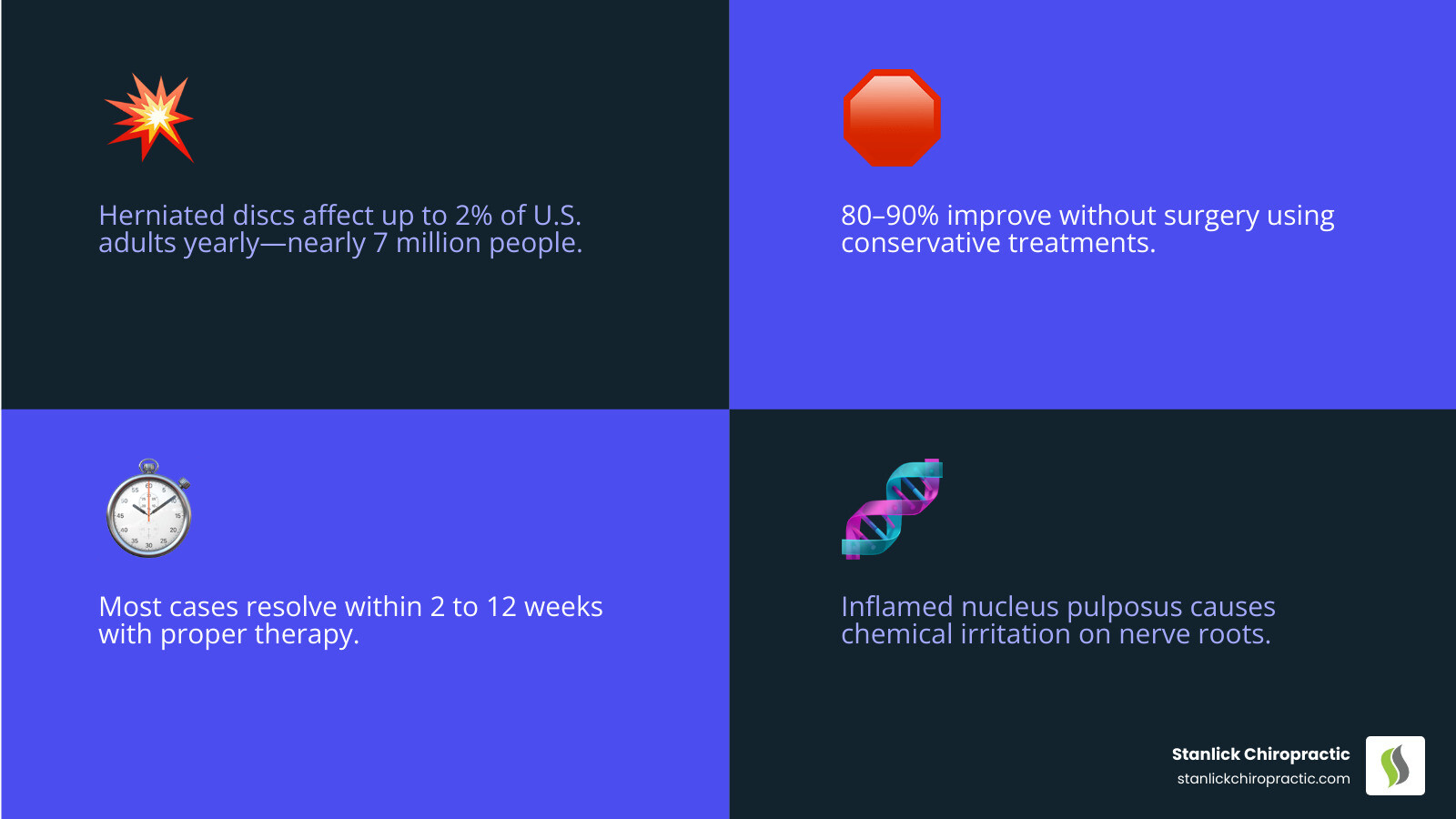
The good news? 80–90% of people with a herniated disc improve without surgery. Most cases resolve within 2 to 12 weeks with the right conservative approach.
Every day, millions of people wake up with sharp, burning, or radiating pain that shoots down their leg or arm — often without knowing why. For many, a herniated disc is the culprit. It’s one of the most common spinal conditions in adults, affecting up to 2% of the U.S. population each year — nearly 7 million people.
The pain can range from a dull ache to a debilitating jolt that makes sitting at a desk — or even walking — feel impossible. If you’re an active person who doesn’t want to slow down, that’s a frustrating reality.
But here’s what most people don’t realize: you have more options than surgery or just waiting it out.
I’m Dr. Mitch Stanlick, a chiropractor based in Murfreesboro, Tennessee, with over two decades of experience helping patients find lasting relief through evidence-based herniated disc pain therapy — without relying on opioids or invasive procedures. Before we dive into each treatment option in detail, let’s build a clear picture of what a herniated disc actually is and why it causes pain.
Understanding Disc Herniation: Causes and Symptoms
To understand a herniated disc, think of your spinal discs as the “jelly donuts” of your back. They have a tough, rubbery exterior (the annulus fibrosus) and a soft, jelly-like center (the nucleus pulposus). These 23 little cushions sit between your 24 vertebrae, acting as shock absorbers every time you walk, jump, or dance.
A herniated disc occurs when a tear or crack in the outer layer allows some of that inner “jelly” to push out. According to research from the Mayo Clinic, this escaped material can compress or irritate nearby nerves. It’s not just the physical pressure that hurts; the nucleus pulposus contains inflammatory chemicals that can cause a chemical “burn” on the nerve root.
This irritation leads to two primary types of pain:
- Sciatica/Radiculopathy: This is the classic “shooting” pain. If the disc is in your lower back, you’ll feel it in your buttocks and down one leg. If it’s in your neck, the pain radiates down your arm.
- Localized Pain: A dull, deep ache directly over the spine where the injury occurred.
Interestingly, many people have herniated discs and don’t even know it. Studies show that over 50% of asymptomatic individuals have some form of disc bulge or herniation visible on an MRI. It only becomes a problem requiring herniated disc pain therapy when that disc material interferes with a nerve.

Common Risk Factors
While an injury can cause a sudden herniation, most cases are the result of gradual, age-related wear and tear called disc degeneration. As we age, our discs lose water content, making them less flexible and more prone to tearing.
Other risk factors include:
- Obesity: Excess body weight puts extra stress on the discs in your lower back.
- Occupation: Jobs that require repetitive lifting, pulling, or twisting increase risk. Interestingly, long-distance truck driving is a risk factor because the combination of long-term sitting and vehicle vibration can fatigue the disc.
- Sedentary Lifestyle: Sitting actually puts more pressure on your spinal discs than standing or lying down.
- Smoking: This is a big one. Smoking reduces oxygen supply to the disc, causing it to break down up to four times faster than in non-smokers.
If you’ve experienced a sudden “pop” in your back followed by pain, you can learn more about disc injury causes here.
Diagnostic Procedures for Herniated Disc Pain Therapy
Before starting any herniated disc pain therapy, we need an accurate map of what’s happening. Diagnosis usually begins with a physical examination. We look for tenderness in the back and check your muscle strength and reflexes.
One of the most common tests we perform is the Straight Leg Raise test. While you lie on your back, we gently lift your affected leg. If you feel pain shooting down the leg between 30 and 70 degrees, it’s a strong indicator of a herniated disc.
Imaging and Nerve Tests
While a physical exam tells us a lot, imaging helps confirm the location.
- MRI: This is the gold standard. It uses magnetic fields to create detailed images of soft tissues, showing us exactly where the disc is protruding and which nerves are pinched.
- CT Scan: Useful if an MRI isn’t an option; it provides a cross-sectional view of the spinal canal.
- X-rays: These don’t show herniated discs, but they help us rule out other causes of pain, like fractures or tumors. Research on imaging for low back pain suggests that unless there are “red flags,” imaging is often delayed for 6 weeks to see if the body heals on its own.
- EMG/Nerve Conduction Studies: These tests measure how well electrical impulses are moving along your nerves, helping us pinpoint exactly which nerve root is damaged.
When to Seek Emergency Care
While most disc issues are not emergencies, there is a rare but serious condition called Cauda Equina Syndrome. This happens when a massive disc herniation compresses the entire “horse’s tail” of nerve roots at the end of the spinal cord.
Seek emergency care immediately if you experience:
- Loss of bladder or bowel control.
- “Saddle anesthesia” (numbness in the inner thighs, groin, or back of the legs).
- Sudden, severe weakness in both legs that makes walking impossible.
Effective Nonsurgical Herniated Disc Pain Therapy
We always advocate for a “conservative first” approach. Why? Because the body is remarkably good at healing itself. Over time, the body often reabsorbs the protruding disc material through a process called phagocytosis. Our goal with herniated disc pain therapy is to manage your pain and improve function while that natural process happens.
Scientific research on conservative management shows that up to 90% of symptomatic cases resolve within 6 weeks with non-surgical care.
The First 48 Hours: Activity Modification
In the past, doctors prescribed “bed rest” for back pain. We now know that was a mistake. Too much bed rest leads to stiff joints and weak muscles, which actually slows recovery. Instead, we recommend “activity modification.” Avoid heavy lifting or prolonged sitting, but keep moving. Short, frequent walks (even just 5–10 minutes) help maintain circulation and promote healing.
Heat and Cold Therapy
- Cold: Use ice packs for the first 48 hours to reduce inflammation and numb the sharp pain.
- Heat: After the initial inflammation subsides, switch to heat to relax muscle spasms and increase blood flow to the area.
For those struggling with persistent pain, you can find more info on non-surgical relief here.
Therapeutic Exercises and Chiropractic Rehabilitation
Once the acute pain is under control, we move into the rehabilitation phase. This isn’t just about “stretching”; it’s about re-training the muscles that support your spine.
- Core Strengthening: We focus on the “inner corset” — the transverse abdominis and multifidus muscles. Strong core muscles act like a natural back brace.
- The McKenzie Method: This involves specific movements (usually spinal extensions) designed to “centralize” the pain, moving it out of your leg and back into your lower back, which is a sign of progress.
- Pelvic Tilts and Hamstring Stretches: These help take the mechanical strain off the lower lumbar vertebrae.
Rehabilitation is a collaborative process. We work to restore lost range of movement while you perform daily exercises at home to maintain those gains.
Advanced Non-Invasive Solutions: Spinal Decompression and K-Laser
Sometimes, basic stretching and ice aren’t enough to move the needle. At Stanlick Chiropractic in Murfreesboro, we utilize advanced technology to accelerate the healing of the disc itself.
Spinal Decompression Therapy
This is a game-changer for herniated disc pain therapy. Unlike traditional traction, spinal decompression uses a computerized table to gently stretch the spine.
How it works:
- Negative Pressure: The gentle pull creates a “vacuum” effect (negative intradiscal pressure) inside the disc.
- Retraction: This vacuum can help pull the herniated or bulging disc material back toward the center of the disc.
- Nutrient Diffusion: The “pumping” action of the table encourages the flow of water, oxygen, and nutrient-rich fluids into the disc, which is vital because discs have a very poor natural blood supply.
Many patients find this process so relaxing they actually fall asleep during treatment. You can read about the benefits of spinal decompression therapy and get a deeper answer to “What is spinal decompression?” on our dedicated pages.
K-Laser Therapy
While decompression handles the mechanical pressure, K-Laser therapy handles the cellular inflammation. This Class IV laser uses specific wavelengths of light to penetrate deep into the spinal tissues.
This process, called photobiomodulation, stimulates the mitochondria in your cells to produce more energy (ATP). This leads to:
- Reduced pain and inflammation.
- Faster tissue repair and cellular growth.
- Improved vascular activity.
It’s a painless, warm sensation that provides a powerful boost to the body’s internal repair kit. Check out more info on K-Laser treatments to see if it’s right for your recovery plan.
Lifestyle Modifications and Long-Term Prevention
Once we get you out of pain, our priority shifts to making sure that pain never comes back. Prevention is the best form of herniated disc pain therapy.
- Proper Lifting: Never bend at the waist to pick something up. Always bend your knees and keep your back straight, letting your legs do the heavy lifting.
- Ergonomics: If you work at a desk in Murfreesboro, ensure your monitor is at eye level and your chair provides proper lumbar support. Stand up and move every 30 minutes.
- Smoking Cessation: As mentioned, smoking significantly impacts disc health. Quitting is one of the best things you can do for your spine.
- Weight Management: Losing even five or ten pounds can significantly reduce the “load” your lower back has to carry every day.
Frequently Asked Questions about Herniated Discs
Can a herniated disc heal on its own?
Yes! In fact, about 75% of herniated discs resolve within two to twelve weeks without any major intervention. Your body recognizes the “jelly” outside the disc as a foreign substance and triggers an immune response to break it down and reabsorb it. Our job is to help manage the symptoms and ensure your spine stays mobile during this window.
Is walking good for a herniated disc?
Absolutely. Walking is a low-impact aerobic activity that increases blood flow to the spinal tissues and helps keep the supporting muscles active. We recommend short walks on flat surfaces. If walking increases your leg pain, stop and rest, then try again later for a shorter duration.
How long does it take for therapy to work?
Every body is different, but most patients start to feel significant relief within the first 2 to 4 weeks of a structured herniated disc pain therapy program. For a full “functional” recovery where you can return to heavy lifting or sports, it typically takes 8 to 12 weeks.
Conclusion
A herniated disc can feel like a life-sentence of pain, but the statistics are on your side. With a combination of patience, activity modification, and professional care, the vast majority of people return to their favorite activities without ever needing surgery.
At Stanlick Chiropractic, we believe in providing personalized, affordable treatment plans that focus on the root cause of your pain, not just the symptoms. Whether it’s through targeted chiropractic adjustments, advanced spinal decompression, or K-Laser therapy, we are here to help the residents of Murfreesboro, TN, regain their quality of life.
Don’t let back pain dictate your future. If you’re ready to explore your options for relief, schedule a spinal decompression consultation with us today. We’ll work together to get your “jelly donut” back in working order.


